
Novel ultrasound technology advances battery material recovery
A new peer-reviewed, open-access scientific publication supported by the APOLLO project introduces a novel tube transducer for power ultrasound applications, demonstrating its potential to enhance the recycling of lithium-ion batteries.
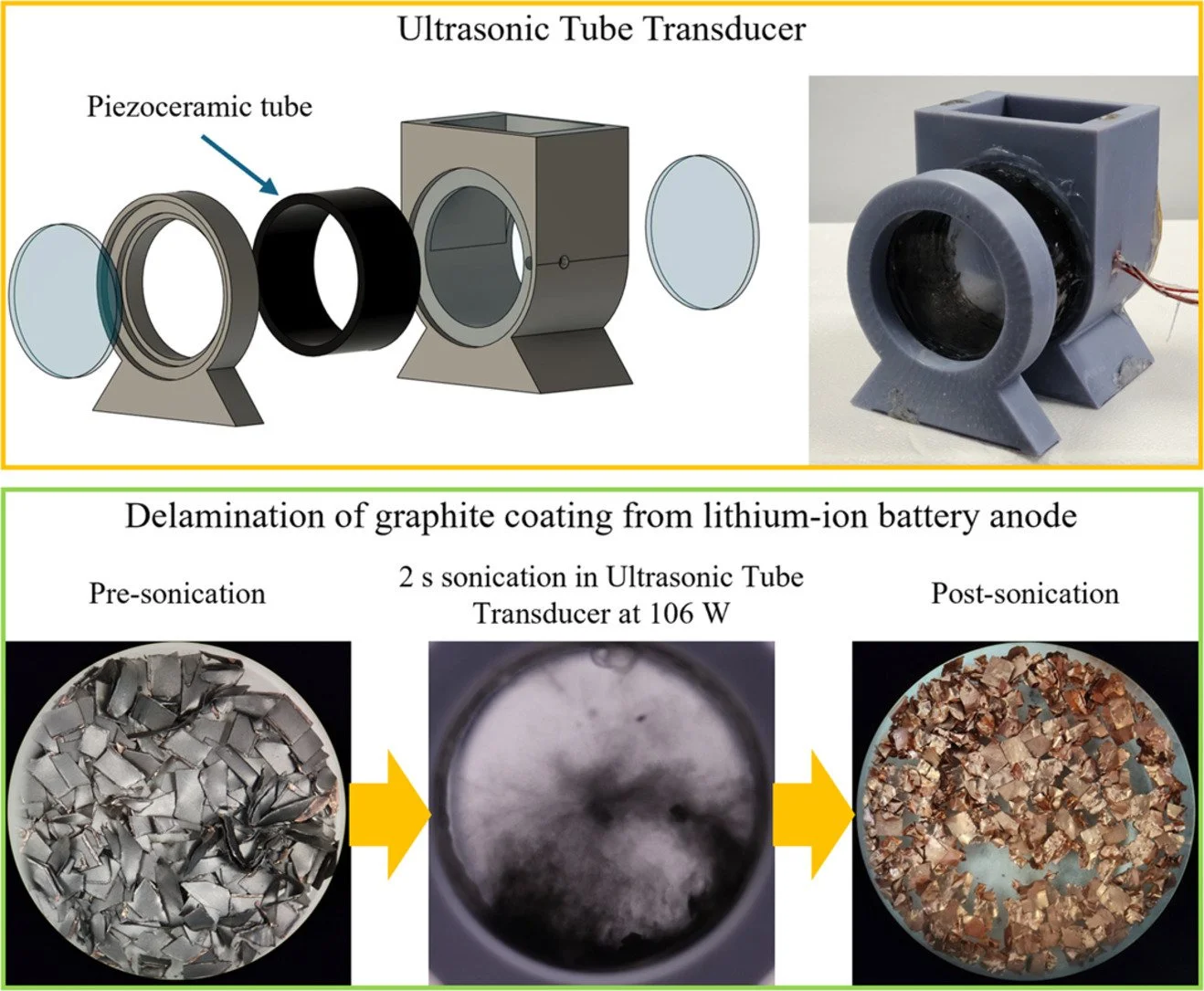
Published in Chemical Engineering and Processing: Process Intensification, the study presents an innovative ultrasound system designed to overcome some of the limitations of conventional ultrasonic technologies. Unlike traditional sonotrodes, the newly developed tube transducer generates high-intensity cavitation throughout its entire bore, enabling more uniform treatment of materials and offering promising opportunities for future high-throughput, flow-based recycling processes.
As a case study, the researchers investigated the delamination of graphite coatings from lithium-ion battery anodes, a crucial step in recovering valuable battery materials. The results demonstrated that the tube transducer achieved more intense and better-distributed cavitation than a conventional sonotrode operating at comparable power, leading to highly efficient graphite removal from both intact anodes and shredded battery material.
Beyond battery recycling, the technology could support the development of scalable ultrasonic processing systems for a wide range of industrial applications where efficient material separation and continuous processing are required.
This research was supported by the APOLLO project and aligns with its mission of advancing circular technologies and innovative material recovery.
